By Manifesto Joe
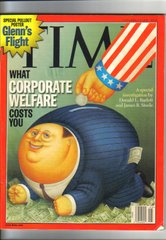
Bashing welfare is a very easy thing to do, and with some reason. I just saw my hometown not long ago, and it looked like a scene from The Last Picture Show. Storefronts that used to thrive were boarded up. Half the town, probably more, is on government assistance of some sort. Agriculture is moribund because of Texas' drought, and there's no industry nearby to speak of. The tax base pretty much consists of the substandard school district, which is heavily subsidized by the federal government, and the local supermarket, which gets much of its money through the food stamp program. Welfare programs appear to have created a town full of dependents.
Couldn't these people work? That's the natural thing to ask. If the city fathers lure in an industry, they would likely have to do it through huge tax abatements, and that wouldn't add much to their tax base.
And then, one can always commute to one of the nearby towns and work at the Wal-Mart store.
Problem is, that probably wouldn't get you entirely off government assistance. Because the pay at Wal-Mart is so shitty -- an average hourly wage of $8.81, I've read -- Wal-Mart "associates" often have to stay on food stamps to be able to feed their families. The company doesn't offer benefits to many of its "associates," so that means the employees have to stay on government health programs like Medicaid and CHIP. Meanwhile, as we the taxpayers pick up the tab for all this, the company rakes in profits for some of the richest people on Earth.
It's an indirect government subsidy, but a subsidy nonetheless. You and I are paying for stuff that any "decent" corporation would offer employees enough money and benefits to afford. From what I've read, the annual subsidies are usually at least $900,000 per store, and they can run as high as $2 million. Here's a link to an article on the subject.
I briefly mentioned tax abatements earlier in this post. This is another way that corporate entities get subsidies, with these coming generally at the local level, in the realm of property taxes. It's the ordinary shmoes in American communities -- including some of the ones who take jobs with these cheap blackmailers -- who end up paying more in property taxes because of the abatements. And if the city and/or county fathers don't put out, they are essentially told, "We'll just take all these jobs someplace where they will."
Yet another problem all this creates is the disincentive to work. With wages so low, and with one often having to commute to a neighboring town to find a peon's job, why work? Why not just sit at home and collect entitlements, when "work" isn't likely to provide a path to a better life?
Yep, it's very easy to cuss people on welfare -- as long as they're the poor ones. It becomes more difficult when it's some of the richest people on the planet who happen to be sucking on the government tits. When poor people do it, it's evidence of moral degeneracy. When the rich do it, it's called "smart business."
Manifesto Joe Is An Underground Writer Living In Texas.
Showing posts with label subsidies. Show all posts
Showing posts with label subsidies. Show all posts
Wednesday, June 12, 2013


Monday, January 3, 2011
Income Disparity Is A Growing Problem
By Manifesto Joe
Socialism for the rich? It looks more and more that way, upon close examination. I remember a job interview (I'm a newspaper journalist) in which the publisher of a medium/small paper talked briefly about competition. "We're all for competition. But not in our particular business. If somebody starts up a paper to compete with us, we're going to do all we can do to beat them and run them out of business."
Fine -- that's the marketplace. You can lose in competition, and the inefficient do. But that points to an inherent contradiction of capitalism. In theory, capitalists laud competition; but in practice, every capitalist wants a monopoly.
But even with that contradiction in mind, the way capitalism is being practiced in America and elsewhere is that many "competitors" are shielded from the rigors of the marketplace. History shows again and again that concentrations of wealth cannot be divorced from political influence: They tend to be parallel. Rich people and giant corporations can afford to hire more and better lobbyists than those who advocate for the poor, labor unions, etc., can ever hope to. It's always been that way, and it probably always will be.
According to journalist David Cay Johnston, over the past 30 or so years, rich people and big corporations have been so lavishly subsidized that they always win. And, subsequently, you, little man and woman, always lose.
Here's a link to articles about Johnston's new book, and to an interview with him.
If you follow the news, it shouldn't be lost on you that cities, counties and states across America are giving subsidies, either in the form of tax breaks or outright payments, to already-rich companies to relocate there, or to expand. What they get in tax breaks, or in flat payments, you have to make up the difference for.
It's reality that a significant number of jobs are generated this way, at least in those localities, as Johnston grants. But the effect on the nation as a whole is nothing short of devastating. The most recent federal deficit figure was $1.3 trillion, a bill we're going to stick future generations with. On the structural deficit, this is the "trickle-up" effect.
Income redistribution doesn't work just one way. The rich are much better at it, and contrary to the prophesy of Karl Marx, history has seemed to be on their side.
The efficiency of the "free market" depends on that which is purely economic functioning independently of political influence. That may have been somewhat possible in Adam Smith's day, but it didn't take long after that for economic power to translate directly into political power. In the halls of Congress or any legislature, money talks; bullshit walks.
How has this affected daily life in the U.S.? Here's another link that illustrates the problem. American workers are vastly more productive than they were in the 1970s, but have gained little in real wages compared to those raking in profits from politically advantageous positions.
So, in practical terms, how can this problem be remedied?
Make the bastards pay
I'm realist enough to know that there's never going to be a real solution to the problem of capitalist success translating directly into political influence. This is one point on which Marx was absolutely correct: There's never going to be any divorce between the two spheres. The only way to address it is to revive the concept of progressive taxation.
There seemed to be a time in America in which many working people more or less understood that capitalism is an insider's game, played with great duplicity. "Traditional" capitalists do plenty of talking about the "free market," but all the while they have Washington and the state capitols overrun with lobbyists seeking all manner of perks. And they get most of them, no matter which major political party is in power. They fare better with Republicans; but Democrats, as we have seen since January 2009, merely talk a better game and usually end up swimming in the same polluted water. Their politicians have to have quid, and plenty of it, to keep their gig going.
Progressive taxation is the only practical answer. Hey, rich guy: You want various governments to subsidize you? Realistically, that's bound to happen. But with that in mind, you must pay commensurately for it, so as to stop shifting the burden down upon those who can least afford to pay.
Let's face the fact that the "free market" is, and has generally always been, a duplicitous sham. The hogs have pretty much always been slopping at the trough, and the biggest ones get the most. It's only when the smaller ones band together that real change is forced upon them.
The people of Dallas-Fort Worth, here in Texas, should be able to see the dilemma quite well. The taxpayers anteed up a pretty penny for Cowboys Stadium in Arlington, subsidizing fabulously wealthy Dallas Cowboys owner Jerry Jones in the bargain. What they got this football season was an NFL team that went 6-10, and that was largely because of Jones' mismanagement, if sports columnists are to be believed. The taxpayers didn't get much of a return on their silly investment.
I don't see an end to such nonsense anytime soon. But I'd like to see Jerry's taxes, and those of others like him, raised dramatically, for all the "little people" to settle up for the price of Jerryworld.
I've got a couple more links that more or less address this subject. Sen. Bernie Sanders, I-Vt., was a dissenter in the Senate on the recent Obama compromise on taxes. Here's some of what he had to say on the subject.
Here's more of what Bernie said, courtesy of Truthout. It's pretty astonishing that the American people are still taking it up the keester so happily while ExxonMobil rakes in $19 billion in profits, and not only pays no income tax, but gets back a $156 million refund from the IRS.
Bernie is an avowed socialist, the only one now in Congress, to my knowledge. I'm sorry to disappoint some out there, but I'm not a true-believing socialist, and therefore I don't think there's ever going to be a way to effectively stop big corporations and wealthy campaign contributors from twisting the arms of lawmakers. I'd say that's especially true since our Supreme Court recently struck down limitations on campaign finance.
The only answer is what can be done to wake people up. A political groundswell is the sole solution, and it's got to start soon. The sole reason for optimism here is that once people start really being hit in their pocketbooks, that's when they actually do something. The best time for that was in 1985, but it still may not be too late.
Manifesto Joe Is An Underground Writer Living In Texas.
Socialism for the rich? It looks more and more that way, upon close examination. I remember a job interview (I'm a newspaper journalist) in which the publisher of a medium/small paper talked briefly about competition. "We're all for competition. But not in our particular business. If somebody starts up a paper to compete with us, we're going to do all we can do to beat them and run them out of business."
Fine -- that's the marketplace. You can lose in competition, and the inefficient do. But that points to an inherent contradiction of capitalism. In theory, capitalists laud competition; but in practice, every capitalist wants a monopoly.
But even with that contradiction in mind, the way capitalism is being practiced in America and elsewhere is that many "competitors" are shielded from the rigors of the marketplace. History shows again and again that concentrations of wealth cannot be divorced from political influence: They tend to be parallel. Rich people and giant corporations can afford to hire more and better lobbyists than those who advocate for the poor, labor unions, etc., can ever hope to. It's always been that way, and it probably always will be.
According to journalist David Cay Johnston, over the past 30 or so years, rich people and big corporations have been so lavishly subsidized that they always win. And, subsequently, you, little man and woman, always lose.
Here's a link to articles about Johnston's new book, and to an interview with him.
If you follow the news, it shouldn't be lost on you that cities, counties and states across America are giving subsidies, either in the form of tax breaks or outright payments, to already-rich companies to relocate there, or to expand. What they get in tax breaks, or in flat payments, you have to make up the difference for.
It's reality that a significant number of jobs are generated this way, at least in those localities, as Johnston grants. But the effect on the nation as a whole is nothing short of devastating. The most recent federal deficit figure was $1.3 trillion, a bill we're going to stick future generations with. On the structural deficit, this is the "trickle-up" effect.
Income redistribution doesn't work just one way. The rich are much better at it, and contrary to the prophesy of Karl Marx, history has seemed to be on their side.
The efficiency of the "free market" depends on that which is purely economic functioning independently of political influence. That may have been somewhat possible in Adam Smith's day, but it didn't take long after that for economic power to translate directly into political power. In the halls of Congress or any legislature, money talks; bullshit walks.
How has this affected daily life in the U.S.? Here's another link that illustrates the problem. American workers are vastly more productive than they were in the 1970s, but have gained little in real wages compared to those raking in profits from politically advantageous positions.
So, in practical terms, how can this problem be remedied?
Make the bastards pay
I'm realist enough to know that there's never going to be a real solution to the problem of capitalist success translating directly into political influence. This is one point on which Marx was absolutely correct: There's never going to be any divorce between the two spheres. The only way to address it is to revive the concept of progressive taxation.
There seemed to be a time in America in which many working people more or less understood that capitalism is an insider's game, played with great duplicity. "Traditional" capitalists do plenty of talking about the "free market," but all the while they have Washington and the state capitols overrun with lobbyists seeking all manner of perks. And they get most of them, no matter which major political party is in power. They fare better with Republicans; but Democrats, as we have seen since January 2009, merely talk a better game and usually end up swimming in the same polluted water. Their politicians have to have quid, and plenty of it, to keep their gig going.
Progressive taxation is the only practical answer. Hey, rich guy: You want various governments to subsidize you? Realistically, that's bound to happen. But with that in mind, you must pay commensurately for it, so as to stop shifting the burden down upon those who can least afford to pay.
Let's face the fact that the "free market" is, and has generally always been, a duplicitous sham. The hogs have pretty much always been slopping at the trough, and the biggest ones get the most. It's only when the smaller ones band together that real change is forced upon them.
The people of Dallas-Fort Worth, here in Texas, should be able to see the dilemma quite well. The taxpayers anteed up a pretty penny for Cowboys Stadium in Arlington, subsidizing fabulously wealthy Dallas Cowboys owner Jerry Jones in the bargain. What they got this football season was an NFL team that went 6-10, and that was largely because of Jones' mismanagement, if sports columnists are to be believed. The taxpayers didn't get much of a return on their silly investment.
I don't see an end to such nonsense anytime soon. But I'd like to see Jerry's taxes, and those of others like him, raised dramatically, for all the "little people" to settle up for the price of Jerryworld.
I've got a couple more links that more or less address this subject. Sen. Bernie Sanders, I-Vt., was a dissenter in the Senate on the recent Obama compromise on taxes. Here's some of what he had to say on the subject.
Here's more of what Bernie said, courtesy of Truthout. It's pretty astonishing that the American people are still taking it up the keester so happily while ExxonMobil rakes in $19 billion in profits, and not only pays no income tax, but gets back a $156 million refund from the IRS.
Bernie is an avowed socialist, the only one now in Congress, to my knowledge. I'm sorry to disappoint some out there, but I'm not a true-believing socialist, and therefore I don't think there's ever going to be a way to effectively stop big corporations and wealthy campaign contributors from twisting the arms of lawmakers. I'd say that's especially true since our Supreme Court recently struck down limitations on campaign finance.
The only answer is what can be done to wake people up. A political groundswell is the sole solution, and it's got to start soon. The sole reason for optimism here is that once people start really being hit in their pocketbooks, that's when they actually do something. The best time for that was in 1985, but it still may not be too late.
Manifesto Joe Is An Underground Writer Living In Texas.
Subscribe to:
Posts (Atom)