By Manifesto Joe
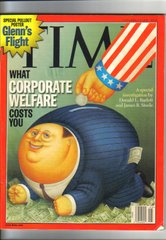
In 2013, America stands at the economic crossroads more starkly than perhaps ever before. The federal budget deficit, though reduced, remains staggeringly high. Two-thirds of U.S. corporations pay no federal income tax, and they employ armies of lawyers and CPAs, plus own scores of lawmakers through campaign contributions, to make sure things stay that way. Their well-paid mouthpieces tell us things can't really be any other way, that we can't be competitive by going back to an arrangement in which corporations paid 39% of the IRS take (Barlett and Steele, citing IRS figures for 1959).
There is some truth in this, and we have seen enough outsourcing and offshoring to know it. Big corporations are now armed with technology and tactics that they didn't have in 1959, and no socialist alternatives to the capitalist system are regarded as viable. Karl Marx predicted that there would be attempts to "reform" capitalism, to ameliorate its more brutal side, but that those efforts would all fail as capitalism stubbornly returns to its more primitive form. A few countries like Sweden and Norway seem to have found a comfortable coexistence of capitalism and socialism, with the mix much more weighted toward the latter than we've generally seen elsewhere in the West. But, as the social safety net is whittled down not only here but in many other countries such as Spain and Greece, the chances of other places in the West reaching a Swedenlike arrangement any time soon are quite remote.
But I don't believe that, in the long run, our corporate masters are going to get their way. The genie is out of the bottle, so to speak. Ordinary people know, from New Deal-era programs such as Social Security and institutions such as labor unions, that there actually is another path.
The Gilded Age, Part Two has been pursued mostly unabated in the U.S. for about 35 years now, and the results should be shocking. In 1982, CEO pay was 42 times that of an average worker. By 2012, pay for the former had swelled to 354 times that of the average U.S. worker. There seems to be no end to the number of apologists for this sort of obscenity, and many people have been cowed into silence as their faces are ground more savagely by the priesthood of "free markets."
Here's a link from the AFL-CIO with more details about this very organized thievery.
But there's nothing like discomfort to wake up the millions. That was what did it in the 1930s, after the first Gilded Age was at long last over. When you got nothin', you got nothin' to lose. It took a painfully long time back then, but it finally happened. And it will happen again. It's been said that history doesn't really repeat itself, but it certainly rhymes. Our corporate masters won't be able to hustle working people with "free" verse for very much longer.
At this point, people aren't uncomfortable enough. We will see that, though, and it won't be that much longer. Real disaster was averted during the meltdown that accompanied The Great Recession, and the means for the bailouts is less likely to be there next time. And there will be a next time, because clearly the high-class hustlers have learned absolutely nothing from the past five years, except perhaps that they very often end up back on top.
People in this country, and in others, saw collectively for decades that things can be different. And I don't think this is at all optimism, because what I see ahead is a lifetime of horror and struggle. Our corporate masters are discovering that they can perform many functions without employing flesh-and-blood humans to do them. But flesh and blood has to eat, has to have potable water, and will demand medical care when sick. During much of the 20th century, people in relatively affluent societies got used to taking such things almost for granted. They can't anymore -- the "social safety net" has too many gaps, and more are being torn on purpose.
We're headed for a time in which Social Security, Medicare and labor unions will be nostalgic folklore. There will be decades of illegal campfires, fights in which the faceless masses suffer horrendous losses, and coastal cities going underwater.
I'd like to see what comes out of all this in, perhaps, a century. But I'm glad that I'm 57 and that my wife and I stayed intentionally childless. I wouldn't want to see what the next two or three generations of Americans will go through. I wouldn't want to be 27 now, and certainly not 17.
Manifesto Joe Is An Underground Writer Living In Texas.
Showing posts with label socialism. Show all posts
Showing posts with label socialism. Show all posts
Wednesday, August 28, 2013


Monday, December 14, 2009
Paul Samuelson, 1915-2009: A Loss In A Time Of Economic Illiteracy
By Manifesto Joe
Paul A. Samuelson, America's first Nobel laureate in economics, died Sunday at his Massachusetts home at age 94. He had lived long and accomplished great things, so I wouldn't normally have taken much note of his passing.
But Dr. Samuelson represents the passing of more than just one person. This was perhaps the last great economist who saw firsthand the transformation of American capitalism, and he went on to profoundly change the way many academics approach the discipline.
However, his passing is especially disheartening when one surveys the U.S. landscape and sees how little change his innovative thinking has wrought on Main Street, where Tea Baggers bandy the word "socialism" about without being able to accurately or adequately define it.
Dr. Samuelson was not a socialist, but rather a Keynesian, heavily influenced by British economist John Maynard Keynes (1883-1946). Like Keynes, Dr. Samuelson was not seeking an end to private ownership of the means of production. Keynes regarded Karl Marx's Das Kapital (1867) as an obsolete text, and far from an adequate prescription to end modern capitalism's shortcomings.
Where both Keynes and later Dr. Samuelson broke with the classical school of economics was on the role of government in finance, trade and the general welfare. Simplistic people on the economic right commonly mislabel this activist/interventionist approach as "socialism," but that's because they don't even know what socialism is. (See my previous post for the Webster's definition.) Mere income redistribution isn't "socialism" -- any time a government entity changes tax policy, subsidizes something, or appropriates public money for any purpose, income is redistributed. It is simply a question of to whom -- and historically, it has more often been the rich who benefited.
The Keynesian school is one that Dr. Samuelson popularized at least to some degree with his seminal Economics textbook (19 editions, first published in 1948).
The New York Times obituary for Dr. Samuelson contains a couple of paragraphs that sum up this peaceful revolution well:
The textbook introduced generations of students to the revolutionary ideas of John Maynard Keynes, the British economist who in the 1930s developed the theory that modern market economies could become trapped in depression and would then need a strong push from government spending or tax cuts, in addition to lenient monetary policy, to restore them. Many economics students would never again rest comfortably with the 19th-century view that private markets would cure unemployment without need of government intervention.
That lesson was reinforced in 2008, when the international economy slipped into the steepest downturn since the Great Depression, when Keynesian economics was born. When the Depression began, governments stood pat or made matters worse by trying to balance fiscal budgets and erecting trade barriers. But 80 years later, having absorbed the Keynesian teaching of Mr. Samuelson and his followers, most industrialized countries took corrective action, raising government spending, cutting taxes, keeping exports and imports flowing and driving short-term interest rates to near zero.
What the economic semiliterates of the right have failed to understand, generation after generation, was that government activism didn't harm capitalism. On the contrary, it rescued it from a time, around 1932, when the old approach was on its knees and the ref was counting. In the U.S., there were delays and powerful opponents (sound familiar?), but eventually the new approach ushered in our greatest era of growth and prosperity to date, 1945-73, ended only by OPEC's first oil embargo.
Dr. Samuelson's basic text has sold about 4 million copies to date. Back in the early '90s I worked for the publishing house that was doing the revised editions, and it was still one of the most widely adopted textbooks in the country.
Sadly, both Keynes and Dr. Samuelson left much work to be done. The concept of a mixed economy is standard throughout much of the developed world, but still lost on many Americans. I still encounter people, otherwise educated, who think in terms of "free market" versus "command economy," not comprehending the fundamental logical fallacy of such an "either/or" notion.
It isn't "socialism" when governments intervene to mitigate capitalism's once-devastating boom-and-bust cycles. Dr. Samuelson once described the prosperity wrought by laissez-faire as a fragile flower indeed -- the busts can devastate many millions of lives. In the modern economic era, our booms have perhaps been more modest than in the roller-coaster days of the 1920s, but our busts have been commensurately less painful. Even the reactionary Bush II administration, confronted with a potential global economic meltdown, resorted to -- gasp -- Keynesian intervention to avert a repeat of the 1929-33 disaster.
But this year's Tea Party spectacle demonstrates how little has been learned in America, in spite of Dr. Samuelson's life work. As many people as there must be out there who took freshman economics with Dr. Samuelson's book as the course text -- well, there are many antidotes to education, such as cheating, lazy professors and teaching assistants, and just the human habit of reverting, postcollegiate, to the brainwashing of a conservatard home.
The best tribute that nonsocialist progressives can give Dr. Samuelson is to spread the word. This isn't socialism -- it's capitalism tempered by uncommon sense.
A revealing postscript from Dr. Samuelson: "It is not too much to say that the widespread creation of dictatorships and the resulting World War II stemmed in no small measure from the world's failure to meet this basic economic problem [the Great Depression] adequately."
Manifesto Joe Is An Underground Writer Living In Texas.
Paul A. Samuelson, America's first Nobel laureate in economics, died Sunday at his Massachusetts home at age 94. He had lived long and accomplished great things, so I wouldn't normally have taken much note of his passing.
But Dr. Samuelson represents the passing of more than just one person. This was perhaps the last great economist who saw firsthand the transformation of American capitalism, and he went on to profoundly change the way many academics approach the discipline.
However, his passing is especially disheartening when one surveys the U.S. landscape and sees how little change his innovative thinking has wrought on Main Street, where Tea Baggers bandy the word "socialism" about without being able to accurately or adequately define it.
Dr. Samuelson was not a socialist, but rather a Keynesian, heavily influenced by British economist John Maynard Keynes (1883-1946). Like Keynes, Dr. Samuelson was not seeking an end to private ownership of the means of production. Keynes regarded Karl Marx's Das Kapital (1867) as an obsolete text, and far from an adequate prescription to end modern capitalism's shortcomings.
Where both Keynes and later Dr. Samuelson broke with the classical school of economics was on the role of government in finance, trade and the general welfare. Simplistic people on the economic right commonly mislabel this activist/interventionist approach as "socialism," but that's because they don't even know what socialism is. (See my previous post for the Webster's definition.) Mere income redistribution isn't "socialism" -- any time a government entity changes tax policy, subsidizes something, or appropriates public money for any purpose, income is redistributed. It is simply a question of to whom -- and historically, it has more often been the rich who benefited.
The Keynesian school is one that Dr. Samuelson popularized at least to some degree with his seminal Economics textbook (19 editions, first published in 1948).
The New York Times obituary for Dr. Samuelson contains a couple of paragraphs that sum up this peaceful revolution well:
The textbook introduced generations of students to the revolutionary ideas of John Maynard Keynes, the British economist who in the 1930s developed the theory that modern market economies could become trapped in depression and would then need a strong push from government spending or tax cuts, in addition to lenient monetary policy, to restore them. Many economics students would never again rest comfortably with the 19th-century view that private markets would cure unemployment without need of government intervention.
That lesson was reinforced in 2008, when the international economy slipped into the steepest downturn since the Great Depression, when Keynesian economics was born. When the Depression began, governments stood pat or made matters worse by trying to balance fiscal budgets and erecting trade barriers. But 80 years later, having absorbed the Keynesian teaching of Mr. Samuelson and his followers, most industrialized countries took corrective action, raising government spending, cutting taxes, keeping exports and imports flowing and driving short-term interest rates to near zero.
What the economic semiliterates of the right have failed to understand, generation after generation, was that government activism didn't harm capitalism. On the contrary, it rescued it from a time, around 1932, when the old approach was on its knees and the ref was counting. In the U.S., there were delays and powerful opponents (sound familiar?), but eventually the new approach ushered in our greatest era of growth and prosperity to date, 1945-73, ended only by OPEC's first oil embargo.
Dr. Samuelson's basic text has sold about 4 million copies to date. Back in the early '90s I worked for the publishing house that was doing the revised editions, and it was still one of the most widely adopted textbooks in the country.
Sadly, both Keynes and Dr. Samuelson left much work to be done. The concept of a mixed economy is standard throughout much of the developed world, but still lost on many Americans. I still encounter people, otherwise educated, who think in terms of "free market" versus "command economy," not comprehending the fundamental logical fallacy of such an "either/or" notion.
It isn't "socialism" when governments intervene to mitigate capitalism's once-devastating boom-and-bust cycles. Dr. Samuelson once described the prosperity wrought by laissez-faire as a fragile flower indeed -- the busts can devastate many millions of lives. In the modern economic era, our booms have perhaps been more modest than in the roller-coaster days of the 1920s, but our busts have been commensurately less painful. Even the reactionary Bush II administration, confronted with a potential global economic meltdown, resorted to -- gasp -- Keynesian intervention to avert a repeat of the 1929-33 disaster.
But this year's Tea Party spectacle demonstrates how little has been learned in America, in spite of Dr. Samuelson's life work. As many people as there must be out there who took freshman economics with Dr. Samuelson's book as the course text -- well, there are many antidotes to education, such as cheating, lazy professors and teaching assistants, and just the human habit of reverting, postcollegiate, to the brainwashing of a conservatard home.
The best tribute that nonsocialist progressives can give Dr. Samuelson is to spread the word. This isn't socialism -- it's capitalism tempered by uncommon sense.
A revealing postscript from Dr. Samuelson: "It is not too much to say that the widespread creation of dictatorships and the resulting World War II stemmed in no small measure from the world's failure to meet this basic economic problem [the Great Depression] adequately."
Manifesto Joe Is An Underground Writer Living In Texas.
Conservatives Don't Even Know What Socialism Is
This is from Webster's New World College Dictionary, Third Edition:
socialism: 1 any of various theories or systems of the ownership and operation of the means of production and distribution by society or the community rather than by private individuals, with all members of society or the community sharing in the work and the products
The key words there are "ownership" and "means of production." Income redistribution is not part of the definition.
Now for the video portion of our program:
I love the smell of napalmed right-wing ass in the morning. -- MJ
socialism: 1 any of various theories or systems of the ownership and operation of the means of production and distribution by society or the community rather than by private individuals, with all members of society or the community sharing in the work and the products
The key words there are "ownership" and "means of production." Income redistribution is not part of the definition.
Now for the video portion of our program:
I love the smell of napalmed right-wing ass in the morning. -- MJ
Saturday, February 7, 2009
Is A Capitalist Meltdown Upon Us?
By Manifesto Joe
I'll only be 53 on my next birthday in late July, yet it already seems like I've lived a tiring amount of history. Only 20 years ago, the world saw the meltdown of Soviet-style communism -- and many observers, largely neo-conservatives, interpreted that as an ideological culmination, "the end of history." There was even an influential book written with that title. (Does anyone remember that author now? And, does he want to remember that book? Yeah, I know -- Francis Fukuyama.)
It appears that reversals of fortune can happen quickly. Now it looks like the allegedly venerable ideology of "free-market" capitalism is on the ropes, and in serious danger of going down. Who would have thought it?
Die-hard Marxists did. I've never been one of them, even as a long-ago radical all of 23 years old. I still know three people who have continued to call themselves Marxists in total defiance of dismissal or ridicule, and they are probably gloating a lot now. The economic train wreck they kept dogmatically predicting finally seems to be in front of us.
But even as America sleepwalked through our Second Gilded Age (circa 1981-2005), I grew skeptical of the Marxist vision. "Historical inevitability" always sounded like a religious tenet, without the pure superstition; and Marxism itself, a sort of quasi-religion for embittered atheists.
We should be as cautious about awarding hard-line socialists a victory here, as much as "we" (in the editorial sense) should have checked for our wallets the minute Reagan started talking about trickle-down and Phil Gramm started talking about deregulation. The past century should have taught us that the answer lies in between.
Starting with the excesses of laissez-faire: America has, for the past 30-ish years, seen the roller-coaster ride that happens with that sort of economic policy. An elite grows very rich, a minority near the bottom slips much further down, and most people tend to stagnate in the middle.
There are cycles of boom and bust. The booms are good for most people, but especially good for a few. The latter group inevitably forms a "Why Should I Have To Pay Taxes?" lobby and gets bonanzas from lawmakers eager to please. And since these are the people of ostentation and material success, their influence is great among fashionable "thinkers" of the day.
Now the big bust is upon us. It's a bit like 1933 all over again -- not as grim or total in devastation, but it's likely to get worse. President Barack Obama has warned us that this is so.
But history, with its entire lesson, should be heeded, and it seems like Obama is one who will do so.
There were very good reasons for the meltdown of the Soviet empire 20 years ago. Contrary to right-wing mythology, Reagan and his military buildup had little to do with it. Post-Soviet Russian economists recall the problems as internal, and any intellectually honest person knew what they were. There's no need for me to recite the litany here -- Americans heard it all for decades.
But let's face it, die-hard socialists out there -- state-run enterprises have a poor track record. The employees seem to lack incentives to produce. Cooperatives tend to degenerate into personal conflict, power struggles and chaos. And as for the concentration of power in the hands of "vanguard revolutionaries" -- the horrors and enormities of that have been abundant just in the past century.
I don't think it's hard to argue for a sense of balance and measure. In America, it seems like the compromising wheeler-dealers -- the FDRs, the Trumans, the LBJs, the Ted Kennedys -- got more done for working Americans than any of our homegrown radicals ever did.
But there is little doubt that there's been a sea change, and it's been back toward socialist thinking. The Nobel Prize committees have not been known for their sympathy toward socialist-leaning economists, yet Nobel Laureate economist Joseph Stiglitz has more or less come out in favor of the nationalization of U.S. banks. That would be a major step toward socialism of some fashion. Why not? We've just given the bastards $700 billion in taxpayer money to keep them in business. Here's a link to the interview with Stiglitz.
And, it appears that such state power would be the only thing to force the shameless swine who run these enterprises to behave themselves. Sen. Claire McCaskill, D-Mo., made a speech on the Senate floor about the Wall Street oinkers who had themselves awarded $18.4 billion in bonuses while their enterprises got in on the aforementioned $700 billion, because of reckless and disastrous mismanagement. Here's another link to reports on this issue, and to a video of McCaskill's speech. Be patient, the video seems very rough.
So, what should be the ultimate American destination, in an era of "capitalist" meltdown? The Swedes, with a hybrid socialist-capitalist system, don't seem to do badly, with avowed Socialists predominantly in power since 1929. Their booms are smaller, but so are their busts. Their people don't live in fear of homelessness or inability to afford basic health care. Right-wing humorist P.J. O'Rourke, when asked about the Swedes' seeming happiness with their stable system, said that they are all insane -- but that their insanity is distributed equally among the people.
It's a funny line. But there's nothing funny about facing a mortgage foreclosure, or about the welfare rolls shrinking even as joblessness is rapidly expanding. With a growing U.S. underclass, it may be time to take a second look at the socialist mind-set -- despite the old Marxist baggage. Nobody requires us to go to extremes.
Manifesto Joe Is An Underground Writer Living In Texas.
I'll only be 53 on my next birthday in late July, yet it already seems like I've lived a tiring amount of history. Only 20 years ago, the world saw the meltdown of Soviet-style communism -- and many observers, largely neo-conservatives, interpreted that as an ideological culmination, "the end of history." There was even an influential book written with that title. (Does anyone remember that author now? And, does he want to remember that book? Yeah, I know -- Francis Fukuyama.)
It appears that reversals of fortune can happen quickly. Now it looks like the allegedly venerable ideology of "free-market" capitalism is on the ropes, and in serious danger of going down. Who would have thought it?
Die-hard Marxists did. I've never been one of them, even as a long-ago radical all of 23 years old. I still know three people who have continued to call themselves Marxists in total defiance of dismissal or ridicule, and they are probably gloating a lot now. The economic train wreck they kept dogmatically predicting finally seems to be in front of us.
But even as America sleepwalked through our Second Gilded Age (circa 1981-2005), I grew skeptical of the Marxist vision. "Historical inevitability" always sounded like a religious tenet, without the pure superstition; and Marxism itself, a sort of quasi-religion for embittered atheists.
We should be as cautious about awarding hard-line socialists a victory here, as much as "we" (in the editorial sense) should have checked for our wallets the minute Reagan started talking about trickle-down and Phil Gramm started talking about deregulation. The past century should have taught us that the answer lies in between.
Starting with the excesses of laissez-faire: America has, for the past 30-ish years, seen the roller-coaster ride that happens with that sort of economic policy. An elite grows very rich, a minority near the bottom slips much further down, and most people tend to stagnate in the middle.
There are cycles of boom and bust. The booms are good for most people, but especially good for a few. The latter group inevitably forms a "Why Should I Have To Pay Taxes?" lobby and gets bonanzas from lawmakers eager to please. And since these are the people of ostentation and material success, their influence is great among fashionable "thinkers" of the day.
Now the big bust is upon us. It's a bit like 1933 all over again -- not as grim or total in devastation, but it's likely to get worse. President Barack Obama has warned us that this is so.
But history, with its entire lesson, should be heeded, and it seems like Obama is one who will do so.
There were very good reasons for the meltdown of the Soviet empire 20 years ago. Contrary to right-wing mythology, Reagan and his military buildup had little to do with it. Post-Soviet Russian economists recall the problems as internal, and any intellectually honest person knew what they were. There's no need for me to recite the litany here -- Americans heard it all for decades.
But let's face it, die-hard socialists out there -- state-run enterprises have a poor track record. The employees seem to lack incentives to produce. Cooperatives tend to degenerate into personal conflict, power struggles and chaos. And as for the concentration of power in the hands of "vanguard revolutionaries" -- the horrors and enormities of that have been abundant just in the past century.
I don't think it's hard to argue for a sense of balance and measure. In America, it seems like the compromising wheeler-dealers -- the FDRs, the Trumans, the LBJs, the Ted Kennedys -- got more done for working Americans than any of our homegrown radicals ever did.
But there is little doubt that there's been a sea change, and it's been back toward socialist thinking. The Nobel Prize committees have not been known for their sympathy toward socialist-leaning economists, yet Nobel Laureate economist Joseph Stiglitz has more or less come out in favor of the nationalization of U.S. banks. That would be a major step toward socialism of some fashion. Why not? We've just given the bastards $700 billion in taxpayer money to keep them in business. Here's a link to the interview with Stiglitz.
And, it appears that such state power would be the only thing to force the shameless swine who run these enterprises to behave themselves. Sen. Claire McCaskill, D-Mo., made a speech on the Senate floor about the Wall Street oinkers who had themselves awarded $18.4 billion in bonuses while their enterprises got in on the aforementioned $700 billion, because of reckless and disastrous mismanagement. Here's another link to reports on this issue, and to a video of McCaskill's speech. Be patient, the video seems very rough.
So, what should be the ultimate American destination, in an era of "capitalist" meltdown? The Swedes, with a hybrid socialist-capitalist system, don't seem to do badly, with avowed Socialists predominantly in power since 1929. Their booms are smaller, but so are their busts. Their people don't live in fear of homelessness or inability to afford basic health care. Right-wing humorist P.J. O'Rourke, when asked about the Swedes' seeming happiness with their stable system, said that they are all insane -- but that their insanity is distributed equally among the people.
It's a funny line. But there's nothing funny about facing a mortgage foreclosure, or about the welfare rolls shrinking even as joblessness is rapidly expanding. With a growing U.S. underclass, it may be time to take a second look at the socialist mind-set -- despite the old Marxist baggage. Nobody requires us to go to extremes.
Manifesto Joe Is An Underground Writer Living In Texas.
Sunday, November 2, 2008
Republicans Who Call Obama A Socialist Are Showing Either Ignorance Or Desperation
By Manifesto Joe
In the demented spirit of a godfather of American fascism, Joe McCarthy, plenty of Republicans, led by McCain attack dog Sarah Palin, are hurling the dreaded "S" word at Barack Obama. It's right-wing regurgitation, like projectile vomit.
The dreaded word in McCarthy's time was "communist." Now it is "socialist," and the far right bases this on Obama's clearly stated intention to enact very limited income redistribution for the benefit of working-class and middle-income Americans.
This misnomer reveals the stupidity of those who use it with any sincerity, and the desperation of those who actually took political science and economics in college and surely know better.
Socialism defined
Here's a basic definition of "socialism," from Webster's New World College Dictionary:
1. any of various theories or systems of the ownership and operation of the means of production and distribution by society or the community rather than by private individuals, with all members of the society or the community sharing in the work and the products.
Please note that the crucial part of the definition has to the with "the means of production and distribution." I am unaware that Obama has ever advocated nationalization of industries, Israeli-style kibbutzes or anything else that characterizes bona fide socialism. He is clearly, like almost all other American progressives, a welfare capitalist. He favors a system of private ownership, but with restraints, checks and balances, and limited intervention in the public interest.
Many conservatives, being ignorant, disingenuous, or both, have greatly expanded the definition of "socialism" to include any and all kinds of income redistribution that works for the benefit of those roughly at or below median income. To broadly paraphrase one of their heroes, Adam Smith, the richer people among them say nothing of their own gains; they complain only of those of other people.
Any time any public entity, whether a local hospital district or the federal government, makes any decision about taxation and/or appropriates money for anything, income is redistributed. It's a question of to whom.
What Americans have seen for about 35 years, more rapidly at times but always steadily, has been socialism for the rich, certainly by the "broader" definition of the right. A federal tax structure that was once progressive, and remains so on paper in some senses with the retention of brackets, has been gradually rendered impotent by the fine scalpel of legislators and tax lawyers. Most corporations now pay little if any income tax, and the very wealthy have myriad shelters with which they happily dodge responsibility for upkeep of the infrastructure, or even for bankrolling the latest war meant to increase their profits.
Socialism for the rich
As for socialism for the rich, I won't even go into corporate welfare, intrinsic advantages of the rich in the legal system, the system of legal bribery we call campaign finance, etc. I'm just sticking with their definition -- redistribution of income. The distribution of wealth is more unequal than it has been since 1929. (Remember what happened that year?) And this hasn't happened by accident. The '80s supply-side economists led by Arthur Laffer and David Stockman were quite above board in their intention to favor corporations and the rich in taxation, in the apparent belief that such policy would spur investment, create jobs, actually increase tax revenue, and result in "trickle-down."
For the most part, with some interruptions during the Clinton administration, the program of socialism for the rich was put over, and with accompanying indoctrination against anything faintly liberal or progressive. The New Deal was ancient history; and in the minds of many, the opportunistic right succeeded in perversely melding it with the failure of Soviet socialism, or with anything that strayed in the very least from a laissez-faire, supply-side party line.
I stopped being a fan of Ralph Nader after he ensured the presidency for an apocalyptic buffoon like George W. Bush. But Nader said something on a debate show that has stuck with me since: "They (the big corporations) want to socialize their losses and privatize their profits." Never was anything truer said.
Obama, though merely bringing a rather mild bourgeois liberalism back to the table, faces the wrath of fools conned by this right-wing economic nonsense, and the venom of those who would use ignorant "fellow travelers" of the far right to stay in control of the wheel.
But, with two days left until the deciding moment, history appears to be tilting toward Obama. Americans have had 28 years to endure "upscale" socialism. Many who don't listen to frothing-at-the-mouth rhetoric know firsthand what such policies have done to them. Indications are that a large turnout of such folks will hugely favor Obama.
Here's a link that shines more light on the subject. There aren't many real socialists left in America, but here's what their presidential candidate thinks about Obama. And, here's one more from the MSM, its own nasty self.
Meanwhile, "this one" voted early -- and I suppose it's not hard to guess that "this one" voted for "that one." I urge anybody who hasn't done the same yet to get to the polls Tuesday. We don't want to see the future postponed for another four years.
Manifesto Joe Is An Underground Writer Living In Texas.
In the demented spirit of a godfather of American fascism, Joe McCarthy, plenty of Republicans, led by McCain attack dog Sarah Palin, are hurling the dreaded "S" word at Barack Obama. It's right-wing regurgitation, like projectile vomit.
The dreaded word in McCarthy's time was "communist." Now it is "socialist," and the far right bases this on Obama's clearly stated intention to enact very limited income redistribution for the benefit of working-class and middle-income Americans.
This misnomer reveals the stupidity of those who use it with any sincerity, and the desperation of those who actually took political science and economics in college and surely know better.
Socialism defined
Here's a basic definition of "socialism," from Webster's New World College Dictionary:
1. any of various theories or systems of the ownership and operation of the means of production and distribution by society or the community rather than by private individuals, with all members of the society or the community sharing in the work and the products.
Please note that the crucial part of the definition has to the with "the means of production and distribution." I am unaware that Obama has ever advocated nationalization of industries, Israeli-style kibbutzes or anything else that characterizes bona fide socialism. He is clearly, like almost all other American progressives, a welfare capitalist. He favors a system of private ownership, but with restraints, checks and balances, and limited intervention in the public interest.
Many conservatives, being ignorant, disingenuous, or both, have greatly expanded the definition of "socialism" to include any and all kinds of income redistribution that works for the benefit of those roughly at or below median income. To broadly paraphrase one of their heroes, Adam Smith, the richer people among them say nothing of their own gains; they complain only of those of other people.
Any time any public entity, whether a local hospital district or the federal government, makes any decision about taxation and/or appropriates money for anything, income is redistributed. It's a question of to whom.
What Americans have seen for about 35 years, more rapidly at times but always steadily, has been socialism for the rich, certainly by the "broader" definition of the right. A federal tax structure that was once progressive, and remains so on paper in some senses with the retention of brackets, has been gradually rendered impotent by the fine scalpel of legislators and tax lawyers. Most corporations now pay little if any income tax, and the very wealthy have myriad shelters with which they happily dodge responsibility for upkeep of the infrastructure, or even for bankrolling the latest war meant to increase their profits.
Socialism for the rich
As for socialism for the rich, I won't even go into corporate welfare, intrinsic advantages of the rich in the legal system, the system of legal bribery we call campaign finance, etc. I'm just sticking with their definition -- redistribution of income. The distribution of wealth is more unequal than it has been since 1929. (Remember what happened that year?) And this hasn't happened by accident. The '80s supply-side economists led by Arthur Laffer and David Stockman were quite above board in their intention to favor corporations and the rich in taxation, in the apparent belief that such policy would spur investment, create jobs, actually increase tax revenue, and result in "trickle-down."
For the most part, with some interruptions during the Clinton administration, the program of socialism for the rich was put over, and with accompanying indoctrination against anything faintly liberal or progressive. The New Deal was ancient history; and in the minds of many, the opportunistic right succeeded in perversely melding it with the failure of Soviet socialism, or with anything that strayed in the very least from a laissez-faire, supply-side party line.
I stopped being a fan of Ralph Nader after he ensured the presidency for an apocalyptic buffoon like George W. Bush. But Nader said something on a debate show that has stuck with me since: "They (the big corporations) want to socialize their losses and privatize their profits." Never was anything truer said.
Obama, though merely bringing a rather mild bourgeois liberalism back to the table, faces the wrath of fools conned by this right-wing economic nonsense, and the venom of those who would use ignorant "fellow travelers" of the far right to stay in control of the wheel.
But, with two days left until the deciding moment, history appears to be tilting toward Obama. Americans have had 28 years to endure "upscale" socialism. Many who don't listen to frothing-at-the-mouth rhetoric know firsthand what such policies have done to them. Indications are that a large turnout of such folks will hugely favor Obama.
Here's a link that shines more light on the subject. There aren't many real socialists left in America, but here's what their presidential candidate thinks about Obama. And, here's one more from the MSM, its own nasty self.
Meanwhile, "this one" voted early -- and I suppose it's not hard to guess that "this one" voted for "that one." I urge anybody who hasn't done the same yet to get to the polls Tuesday. We don't want to see the future postponed for another four years.
Manifesto Joe Is An Underground Writer Living In Texas.
Subscribe to:
Comments (Atom)